The Rescue Loop: When Leaders Keep Taking Over
Why capable teams sometimes get caught between too much trust and too much management.
by Jason Reid, October 4, 2026
Leaders often struggle to find the balance between delegation and micromanagement. We want to give capable people ownership, but when problems become urgent, we sometimes end up taking the work back.
The Ship Analogy
Imagine you’re the captain of a ship.
You’ve plotted the course, given a trusted senior officer responsibility for navigation, and left the bridge to attend to the many other duties that come with being captain.
You have every reason to trust this person. They’re experienced, capable, and know what they’re doing. You shouldn’t need to stand over their shoulder watching every adjustment to the wheel.
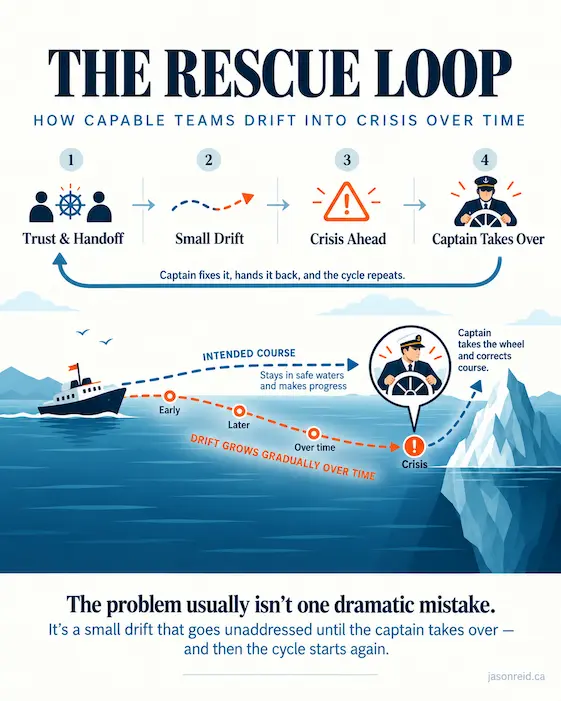
But somewhere along the journey, the ship begins to drift.
At first, it’s barely noticeable. A slight deviation from the intended course. Nothing particularly alarming. But as time passes, that small deviation becomes increasingly significant.
Meanwhile, you are busy elsewhere on the ship, working away and assuming everything is progressing as planned.
Eventually, you return to the bridge and discover they’re heading straight for an iceberg.
There is no longer much time for a discussion about navigation. You take the wheel, change course, and steer the ship to safety.
Disaster avoided.
But what happens next?
Do you hand the wheel back to the senior officer and disappear again, hoping things will be different? After all, you both now know that if something goes wrong, you can always step in and save the day. Or do you decide it’s safer to remain on the bridge and personally manage every aspect of navigation?
Neither seems particularly sustainable, yet variations of this scenario happen in organizations all the time.
We give capable people responsibility, trust them to manage it, and turn our attention to other priorities. Problems develop gradually, but sometimes by the time we’re aware of them, they’ve become urgent enough that stepping in and taking over feels necessary.
I call this the Rescue Loop.
The Problem With Always Coming to the Rescue
Occasionally stepping in to rescue someone is part of leadership. Sometimes circumstances demand it, and there isn’t time to do anything else.
The problem develops when rescuing becomes a recurring pattern.
We move between two extremes. First, we give capable people considerable independence, trusting them to manage their responsibilities. When something goes wrong, we swing in the opposite direction and become too deeply involved in their work.
In other words, we end up taking ownership of work we’re trying to delegate to someone else.
The immediate crisis gets resolved, but little changes about how we operate. Eventually, another problem emerges, and we find ourselves rescuing the situation all over again. Over time, this can create an unfortunate dynamic. The leader becomes increasingly overloaded, while the people they’re leading have fewer opportunities to develop the confidence and judgment needed to manage difficult situations independently.
And here’s the irony: rescuing someone repeatedly can eventually convince us that we were right to worry about trusting them in the first place.
So how do we break the pattern?
Sometimes the Problem Starts With What We Don’t Address
One of the central ideas behind my Awkward Leadership™ framework is that we tend to protect ourselves from uncomfortable leadership moments in three predictable ways: we avoid, we dismiss, and we assume.
All three can contribute to the Rescue Loop.
Avoid: We notice something isn’t quite right but hesitate to raise it because we don’t want to seem like we’re micromanaging.
Dismiss: We spot a small concern but decide it probably isn’t significant. After all, the person knows what they’re doing.
Assume: We believe that if someone is struggling, they’ll tell us.
These reactions are understandable, particularly when we’re working with experienced people. Nobody wants to undermine a capable employee by constantly questioning their work.
But returning to our ship analogy, imagine you notice a slight deviation from the intended course and choose not to mention it. Perhaps you assume the senior officer has a good reason for the adjustment, or you don’t want to appear as though you’re questioning their competence.
The longer that drift goes unaddressed, the more significant it becomes.
Sometimes the awkward conversation we’re avoiding today is the very conversation that could prevent us from having to rescue the situation next week.
Address the Problem Without Taking the Wheel
One of the questions I explored during a recent leadership workshop was how to intervene early without assuming ownership of somebody else’s work.
We need to make an important distinction first.
Addressing a problem means dealing with it. Rescuing means taking ownership of it.
If the captain notices the ship drifting off course, they don’t necessarily need to grab the wheel. They could simply ask the officer whether they’ve noticed the deviation and what adjustments they’re planning to make. The officer remains responsible for navigating the ship, but an emerging problem has been brought into the open. We can take a similar approach with our teams.
When you notice something starting to drift, try approaching the conversation in three steps.
- Name what you’re seeing. Rather than making assumptions about what’s happening, open the conversation with an observation. “Here’s what I’m noticing. What’s happening from your perspective?”
- Ask before solving. It can be tempting to immediately offer a solution, particularly when you think you already know what needs to happen. Instead, give the other person room to work through it. “What do you think needs to happen next?”
- Leave ownership with them while offering support. “What do you need from me, and when should we reconnect?”
These aren’t complicated questions, but they change the nature of the conversation. You’re not ignoring the problem, and you’re not taking the work away from someone. You’re making the issue visible while keeping responsibility where it belongs.
Visibility and Micromanagement
Of course, addressing a problem early assumes you know it exists.
One challenge that came up during the workshop was how leaders can become aware of potential issues sooner without constantly checking on people.
I think there’s another important distinction here.
Micromanagement is about controlling the work. Visibility is about knowing when something needs attention.
The captain doesn’t need to stand on the bridge all day to know whether the ship is still on course. There can be agreed-upon checkpoints, regular updates, and clear expectations about when something needs to be brought to the captain’s attention.
The same is true of leadership. We can establish meaningful checkpoints without monitoring every decision. We can make it easier for people to raise concerns without requiring them to seek permission for everything they do.
In fact, a useful question to ask your team might be: “What could we build into the way we work so we’d recognize sooner when something is starting to drift?” The objective isn’t to eliminate independence. It’s to make sure the first time you learn about a serious problem isn’t when everyone is already staring at the iceberg.
Do You Let Them Hit the Iceberg?
There’s an important question that comes up whenever we talk about giving people ownership and allowing them to learn from mistakes.
How far do we let someone go before stepping in? And what happens when there’s an iceberg ahead?
I think most of us would agree that allowing someone to sink the ship in the name of professional development is probably not great leadership.
But taking the wheel every time someone drifts slightly off course isn’t particularly helpful either. How will they ever develop the judgment required to navigate independently?
The challenge is knowing the difference between a recoverable mistake and an unacceptable risk.
Ultimately, we have three possible responses.
- Let them own it. If the consequences are manageable and there’s a meaningful opportunity to learn, give the person room to recognize and correct the problem themselves.
- Stay close. If the risk is increasing, create greater visibility, ask questions, and offer support while allowing them to retain responsibility.
- Step in. If the consequences have reached an unacceptable level, intervention may be necessary. Sometimes the captain really does need to take the wheel.
The question isn’t whether we should ever allow someone to fail. It’s what level of risk we can reasonably allow them to own. And if we’re discovering that the ship is heading toward an iceberg only when we’re moments away from hitting it, perhaps we should also be asking why nobody noticed the drift sooner.
What Happens After You’ve Rescued Someone?
Once we’re back on course, the next question is: what do we do next?
Too often in organizations, everyone is so relieved that the immediate problem has been resolved that they simply move on.
A debrief gives us an opportunity to interrupt that pattern. Not to assign blame, but to understand what needs to change.
Four questions can help:
- What happened?
- When should we have known?
- What should you (the officer) do differently next time?
- What should I (the captain) do differently next time?
I particularly like that fourth question. It acknowledges that the leader has a role in breaking the pattern, too.
Without that conversation, we risk treating the symptoms while leaving the underlying problem untouched.
Breaking the Rescue Loop
There’s no way to eliminate every unexpected problem from leadership, nor should that be the objective. After all, we want people to develop the judgment and confidence to navigate challenges independently, and some of that learning will inevitably involve mistakes.
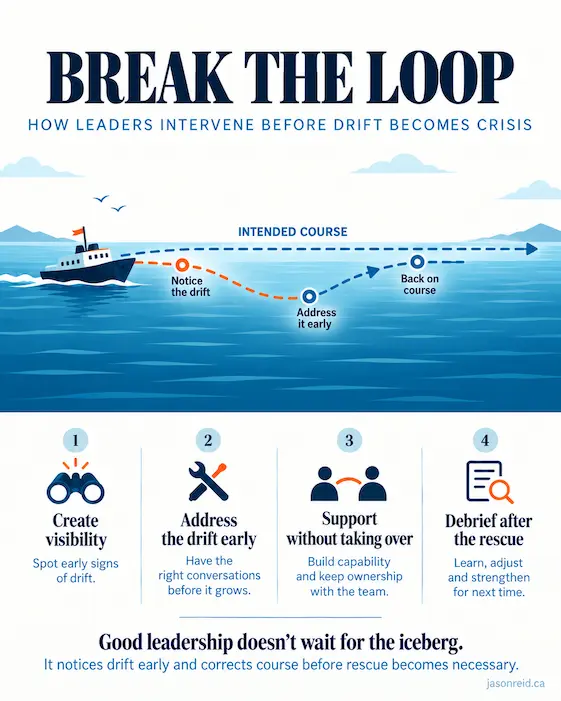
But we also have a responsibility to recognize when a manageable problem is becoming something more serious. So, if you see a problem developing, try to address it without automatically taking over.
If you aren’t seeing problems until it’s too late, create better visibility so concerns can surface earlier.
And if circumstances require you to rescue someone, make sure you have the conversation afterward so the same pattern doesn’t keep repeating.
One of the things I’ve come to appreciate about leadership is that the most helpful response isn’t always the most comfortable one.
Sometimes it’s easier to stay out of someone’s way than to raise an awkward concern. Other times, it’s easier to jump in and fix the problem than to leave someone responsible for working through it.
Good leadership requires knowing when to do the uncomfortable instead.
After all, a captain’s job isn’t to spend the entire voyage holding the wheel. It’s to make sure the ship reaches its destination, while developing a crew they can trust to help get it there.
Jason Reid is a leadership keynote speaker and creator of Awkward Leadership™, a practical framework for navigating the difficult human moments that shape trust, communication and performance. Explore his signature keynote, This Might Get Awkward: Leading the Moments Others Avoid, at jasonreid.ca.