Why Leaders Avoid Difficult Conversations
Difficult conversations are not only about delivering hard truths. Sometimes they are the only way to discover the truth you are missing.
By: Jason Reid, May 14, 2026

When I was producing live television, the on-air host I worked with suddenly started becoming distant.
We had always worked closely between live hits, talking through what we were going to discuss next, and making quick adjustments as the show moved. It was the early morning shift and we had a small but tight crew. Then something changed. Instead of meeting with me between segments, the host started going back to her dressing room.
At first, I tried to explain it away. Maybe she needed space. Maybe she was busy. Maybe I was reading too much into it.
But the tension kept growing. She was short with me, almost irritable, and it became noticeable to the rest of the team. It started to feel like there was a split happening in the middle of a live production environment where trust and communication mattered.
I knew I needed to talk to her. I also kept putting it off.
That is often how avoidance works. It does not always feel like avoidance at first. It can feel like patience, professionalism, or giving someone space, but sometimes those explanations are just a more comfortable way of not having the conversation.
Eventually, I knocked on her dressing room door.
I voiced what I had been observing and for the first time in weeks I saw her smile as she shook her head and made a confession.
“You’re right. I should have told you from the beginning. I’m pregnant. I just don’t want anyone else to know yet.”
It turns out she was dealing with serious morning sickness, which was why she kept disappearing when we weren’t on air.
Once she trusted me with the truth, everything changed. We started doing our preparations in private, and I provided her with any additional help and support she needed to get through her shift.
Not only did she appreciate it, but somehow working through this tension made our work relationship stronger.
Video: Why Leaders Avoid Difficult Conversations
The problem wasn’t what I thought it was, but I couldn’t get to the truth by avoiding the conversation.
That experience changed how I approached difficult conversations. They’re not always about delivering an uncomfortable message. Often they’re the moments when the leader finds out what is really going on.
The Connection Between Trust and Tension
Someone said to me recently, “I can never really trust someone until I’ve had an argument with them.”
I understand her point. While I don’t think leaders should go looking for arguments, the truth is that trust is easy to claim when everything is smooth. It becomes real when working through tension, misunderstanding, or discomfort.
Leaders need to start seeing these tense and potentially uncomfortable moments as opportunities to demonstrate their leadership and build trust within their team.
The Avoidance Pattern
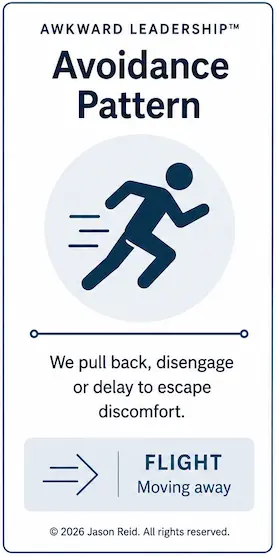
Most leaders know when a difficult conversation needs to happen. The problem is not always awareness. More often, the problem is the moment right before the conversation, when avoidance starts to sound reasonable:
- I’ll wait until I have more information.
- Now is not the right time.
- I don’t want to damage the relationship.
- They probably already know.
- It’s not that serious yet.
- I’ll deal with it if it happens again.
Yes, there may be times when these reasons are valid, but if you find yourself using them repeatedly, chances are you’ve hit what I call The Avoidance Pattern.
Difficult conversations create pressure because they involve uncertainty. You can’t fully control how the other person will react, whether the conversation will become emotional, or whether you will respond perfectly to every situation.
Avoidance rarely keeps the peace. It usually transfers the discomfort to everyone else.
The Cost of Avoidance
Avoidance creates its own damage. Expectations stay unclear, resentment builds, and side conversations start. Other people begin carrying the tension the leader has chosen not to address. Eventually, the team may start to wonder if the leader can’t see the situation, or is just too afraid to deal with it.
When a performance issue sits unaddressed, the team starts working around it, resentment grows, and by the time the leader finally steps in, the original problem is no longer the only issue. Now the leader also has to deal with the damage caused by waiting.
How to Interrupt the Avoidance Pattern
The awareness and courage to lead in the moments that others avoid is part of the framework of what I call Awkward Leadership™. It does not mean rushing into every uncomfortable conversation right away, but instead noticing when your first instinct is to move away simply because it feels awkward.
When you notice this happening, you might want to ask yourself these questions:
- What am I hoping will happen if I wait?
- Who is carrying the cost of my silence?
- What needs to be said here?
- What would I do if I were trying to build trust rather than protect my own comfort?
The point is not to force yourself into every hard conversation immediately, but to stop pretending that waiting is always neutral. Sometimes waiting is wise. Sometimes it is just avoidance with better language. Once you can see the difference, the next step is to have the conversation as directly and humanely as you can.
Learning From Each Awkward Conversation
I’m not going to turn this into a script for what to say, but I do think there is a useful balance to keep in mind: Honesty without empathy can become cruelty, but empathy without honesty can become avoidance. The goal is not to water down the truth, but to stay honest while keeping the conversation focused on observable behaviour, impact, and what needs to change.
Scripts and role-playing can help for some, but difficult conversations are ultimately learned through practice.
Sometimes you handle them well. Sometimes you miss the mark. Sometimes you act with care and the other person is still upset. The important thing is to reflect afterward, learn from what happened, and keep getting better at handling what needs to be addressed.
Remember that difficult conversations do not build trust simply because they are uncomfortable. They build trust because people see that the leader is willing to face challenges directly, fairly, and without avoidance.
This article is part of Jason Reid’s Awkward Leadership™ framework, which explores the hidden patterns that keep leaders and teams from dealing with the issues that matter most. Next article: Why Leaders Dismiss Good Ideas Too Quickly
Jason brings this work to leadership audiences through keynotes and workshops on trust, communication, and high-performance teams.