Why Leaders Dismiss Good Ideas Too Quickly: The Dismissal Reflex
A leadership story about certainty, assumptions, and the ideas we reject without thinking.
By Jason Reid, May 15, 2026

The moment that cemented my reputation as a newsroom leader involved a very long walk to the front of a ballroom.
My reporter and I had just stunned the television industry by winning a major journalism award for a series on Black history and weather. We were the underdogs in the room. The major networks had teams, entourages, and budgets far bigger than ours. We had been forced to sit in the back of the room with journalism students.
When our names were announced, I heard an audible gasp from the crowd. We walked slowly towards the front as the gasps turned to cheers.
Standing beside Canada’s Governor General while flashes popped and cameras clicked, I listened as the event host described our work as original, powerful, and deserving of recognition over far larger productions.
Only I knew the secret, which was that this series almost didn’t happen at all. In fact, I had quickly dismissed it as a ridiculous idea.
The genesis of the project actually began months earlier on a cold January day, when I took my seat at the company’s monthly diversity meeting. As the meeting was about to wrap up, the HR manager turned to me and said, “Black History Month is coming up in a few weeks. Can we do any programming to mark it?”
I explained that our programming mandate was weather and climate so Black history just wasn’t a fit. My response was immediate, confident and decisive, so no one pressed it.
But for some reason the idea stayed with me.
The more I thought about it, the more I found myself playing devil’s advocate.
If we did tell a story about Black history through the lens of weather, what would it even look like?
I began to imagine people on the underground railroad escaping slavery in the Deep American South. After months on the run, some would arrive at their destination in the middle of a brutal Canadian winter.
How did people survive that? I wondered. It might make a good story.
I got in touch with my reporter and explained what I was thinking. Could this idea actually work? It turned out it could. That conversation became the genesis of the award-winning series that shaped both of our careers.
Months later, as we smiled for the cameras, I was still thinking about how quickly and decisively I had dismissed the original idea that started it all.
The more I sat with that thought, the more I realized something uncomfortable: I hadn’t reacted to the idea’s merit. I had reacted to the fact that it didn’t fit my expectations.
After all, the idea came from outside my department, and from someone without journalism experience. It challenged the unwritten rules in my head about what counted as a “real” story. And if I’m honest, it challenged my certainty about what was and wasn’t the focus of our programming.
The Dismissal Reflex
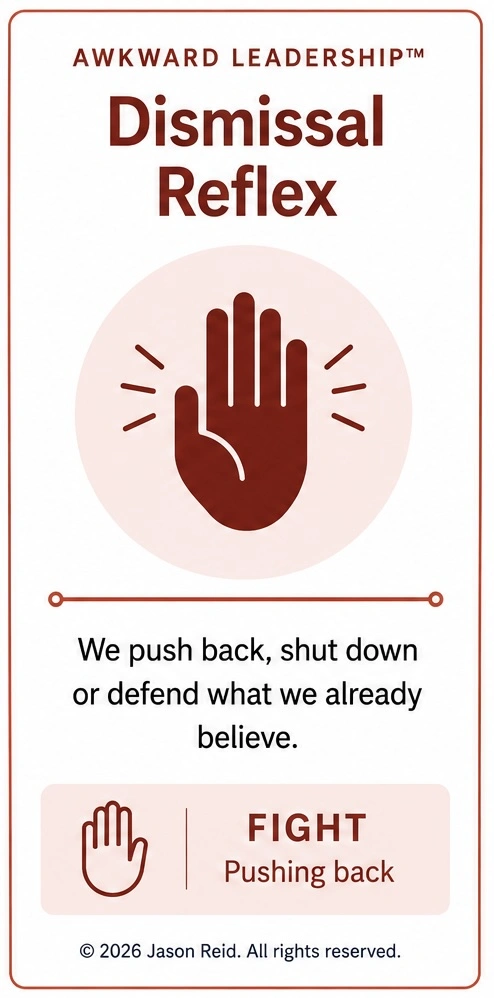
In my Awkward Leadership™ framework, I call this type of behaviour The Dismissal Reflex. It is the tendency to reject ideas too quickly when they feel unfamiliar, come from unexpected sources, or challenge what we think we already know.
Most of us see this at work every day. What we do not always recognize is how much can be lost when a good idea is dismissed too quickly.
The Impact of the Dismissal Reflex
The ideas we dismiss can make careers. They can also break companies. Kodak is often used as the cautionary example. The company had early access to digital photography technology, but its business model was built around selling and processing film. Digital imaging did not fit the assumptions that had made Kodak successful, which made the new technology easier to dismiss.
That’s part of the danger of the Dismissal Reflex. It doesn’t always look like carelessness. Sometimes it looks like experience, expertise, or protecting the business model that has always worked.
How to Counter The Dismissal Reflex
Of course, not every idea deserves more time. In many leadership roles, dismissing weak ideas quickly is part of keeping a team focused. The problem is not that you say no. The problem is saying no before you have understood what you are really reacting to.
One way to counter The Dismissal Reflex is to build enough psychological safety that team members are willing to question or defend a quick rejection. Another is to create enough space for reflection, because sometimes the ideas we dismiss too quickly are the ones that keep returning to mind.
When an idea I’ve dismissed nags at me, I try to treat it as a signal to pause. Instead of saying, “That can’t be done,” I ask, “If we had to do this, how would we make it work?” Then I ask, “What might we lose if we dismiss this too quickly?” and “What might we gain if we gave it more thought?”
These are not revolutionary leadership questions, but when we dismiss ideas too quickly, we never get the chance to ask them.
The harder question comes next: “Why did I really dismiss this in the first place?”
That question is often more uncomfortable because it can reveal ego, certainty, status, habit, or the desire to protect the status quo. Questioning our own motives is not easy, but leadership often requires us to examine the reaction beneath the decision.
I still think about that awards show. It was a great career boost that almost never happened. Not because it lacked merit, but because I almost mistook familiarity for good judgment.
This article is part of Jason Reid’s Awkward Leadership Framework
Additional articles include: Why Do Leaders Avoid Difficult Conversations At Work?