What is Awkward Leadership?

The hidden patterns that keep leaders from dealing with what matters most.
This short highlight reel gives you a quick sense of Jason’s storytelling, humour, and the leadership themes.
Where Awkward Leadership Began
By Jason Reid, Published May 12, 2026
I still remember the first time it happened. I was only a week or two into my role as the head of the news department at a national television network. We were interviewing a writing candidate, and I was late to the meeting.
I rushed in, quickly introduced myself and raised my arm for the obligatory handshake. There was an awkward pause that seemed like forever, and I felt my face go red as I realized the candidate did not have a right arm! I was sure my face showed the shock, but the candidate was gracious and shook my right hand with her left.
We sat down and began the interview. I enthusiastically read out some of the questions I had written down, but I was not really listening to the answers. Without being conscious of it, I had mentally checked out of the conversation.
Why? All I could think of was that awkward moment with my hand raised in the open air and my crimson face. What was the HR manager thinking about me? What was the candidate thinking? All I could think of was how embarrassing it must have appeared to everyone involved.
Once I was back in the privacy of my office, I realized my real mistake was having mentally checked out during the interview. I had made almost zero notes from the meeting, and I couldn’t even remember what had been said. Rather than engaging with the candidate, I had been hiding in my own head, wanting the awkwardness to just go away.
This wasn’t the first time as a leader I felt the urge to hide. I noticed that it cropped up to some degree every time there was an awkward or uncomfortable situation or decision to be made. I also noticed it wasn’t unique to me.
Over time, I began to understand this wasn’t just about awkward moments. It pointed to something larger about leadership itself. It was a specific pattern of hiding. My goal was to find an antidote, something I now call Awkward Leadership™.
How Leaders Hide
It’s human nature to avoid the awkward, the uncomfortable and the unscripted. But these are the moments that build trust, confidence, innovation and performance. The best leaders lead in the moments that others avoid.
The Hiding Instinct
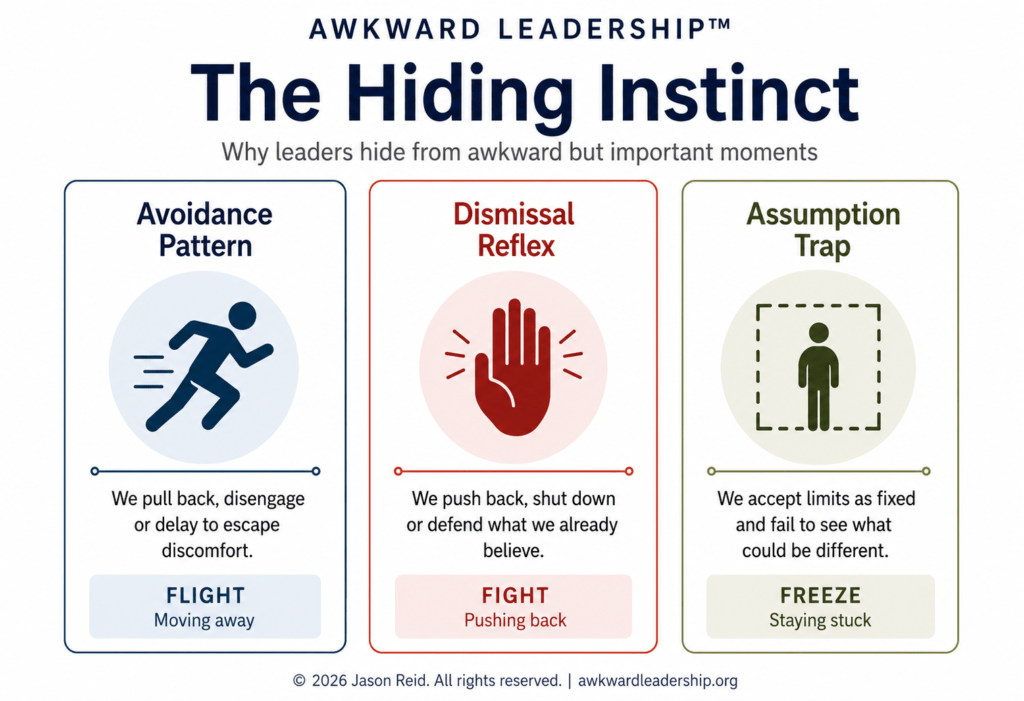
When discomfort appears, people often protect themselves by concealing, deflecting or withdrawing. I call this The Hiding Instinct. It shows up in three protective patterns.
The Avoidance Pattern
This is what happened to me after the handshake. An uncomfortable human moment occurred, and I instinctively withdrew and stopped engaging. This avoidance pattern is common when leaders know they need to have uncomfortable performance conversations with their staff.
The result is this: Problems grow that don’t get addressed and trust declines when teams feel no one is willing to address an obvious issue.
The Dismissal Reflex
Innovative or necessary ideas are often dismissed quickly when brought to the leader’s attention. They may use phrases like “It doesn’t work,” “We tried that,” or “That doesn’t fit with our system.” The leader may excuse the dismissal reflex as a shortcut to save time, effort or mental bandwidth, but sometimes it may be because the idea challenges the leader’s worldview or comes from outside the leader’s trusted circle of advisors.
I learned early on that the dismissal reflex is worth becoming aware of. I casually dismissed a programming content idea from our HR manager because I thought it was ridiculous, but when I re-examined it, I realized that the reason I had dismissed it was that it came from outside my team. We went ahead with the idea, and it became my team’s first award-winning news series, winning us prestige and success.
The Assumption Trap
We often place limits on new ideas and approaches by making assumptions about what can be changed and what can’t. Assumptions are also a type of hiding. Rather than asking better questions, leaders sometimes accept self-imposed limits. Those assumptions can waste time, restrict new ideas, and keep a team stuck inside a problem that may be more solvable than it appears.
I once spent several meetings discussing accommodations for an employee with sensitive hearing who sat next to a very loud door without realizing the door could be fixed by changing a ten-cent screw.
These hiding patterns aren’t random. They resemble familiar human responses to pressure. We move away from discomfort (flight), push back against it (fight), or default to what feels fixed (freeze). In leadership, those responses show up as avoidance, dismissal and unchallenged assumptions.
So, as leaders, how do we ensure we don’t fall into these patterns?
When employees see their leaders hide, through avoidance, dismissal or assumptions, trust plummets and so does performance.
Enter Awkward Leadership™
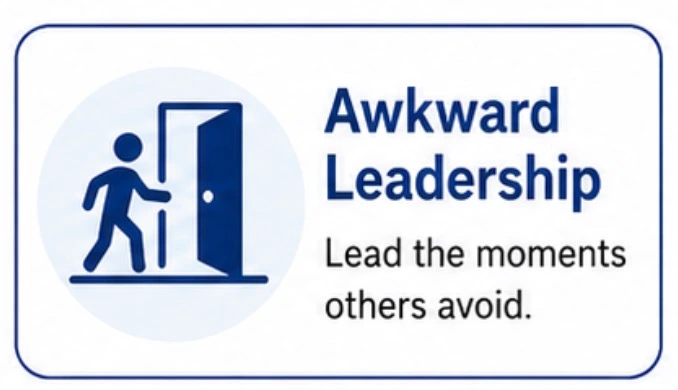
Awkward Leadership is the practice of recognizing The Hiding Instinct and moving toward the moments others avoid, knowing those moments are often where trust is built, innovation starts and performance strengthens.
We interrupt the Avoidance Pattern by asking leaders to stay engaged when discomfort appears. That may mean communicating more clearly, continuing the conversation, or addressing a problem before silence allows it to grow.
We interrupt the Dismissal Reflex by asking leaders to pause before rejecting an idea too quickly. The useful question is not only, “Does this idea work?” but also, “Why am I reacting this strongly to it?” Sometimes an idea is dismissed because it lacks merit. Sometimes it is dismissed because it challenges a leader’s certainty, status, or assumptions.
We interrupt the Assumption Trap through inquiry. Instead of accepting limits as fixed, leaders need to ask better questions. “What are we assuming?”, “What have we stopped questioning?” and “Is this truly impossible, or have we just learned to work around it?”
None of this is complicated in theory. But in practice, Awkward Leadership requires self-awareness, empathy, clear communication, and a willingness to be vulnerable.
That is where vulnerability and psychological safety meet. When a leader takes an appropriate interpersonal risk, it can make it safer for others to speak honestly, admit mistakes, ask questions, or reveal barriers they have been carrying quietly.
Psychological Safety and Team Performance
Google’s own research supports the importance of that kind of team environment. When Google studied what made teams effective, they found that success depended less on who was on the team and more on how the team worked together. The most important dynamic they identified was psychological safety: the belief that people can take interpersonal risks without being embarrassed or punished for admitting a mistake, asking a question, or offering a new idea.
In other words, psychological safety does not improve performance because people feel comfortable all the time. It improves performance because people are more willing to bring forward the information a team needs: mistakes, risks, concerns, questions, ideas, or assumptions that need to be challenged.
That is where Awkward Leadership fits in. The Hiding Instinct explains why people hold back. Awkward Leadership is the practice of interrupting that instinct in the moments where trust, candor, and performance are either built or broken.
Vulnerable Leadership and Communication
I learned early on that vulnerability could be more than a personal leadership trait. It could change performance. In fact, the biggest successes of my career came about because of it.
I took over a television news department that was struggling. The staff were talented, but over the previous few years they had seemingly become stuck. The number and quality of our news reports were declining significantly. It was my job to change this trend, which would be difficult since no one knew the cause.
I also had a second problem that was more personal. I had two chronic illnesses, and I knew they would impact my work from time to time.
So, during our first national news meeting, after I had outlined my vision for the department, I decided to do something awkward and vulnerable. I let my staff know about my health challenges, the impact it might have on the team (such as occasional absences and trips to the hospital) and how we would work around those challenges.
That moment changed the direction of the entire department.
In the two weeks that followed, nearly half of my staff contacted me privately. They shared challenges they had been carrying quietly: chronic health problems, mental health issues, neurodivergence, and other invisible disabilities. Those challenges were creating real barriers to their work, but the barriers had remained hidden because people hadn’t felt safe enough to talk about them.
That was when I began to understand the real problem. Our productivity issue was not caused by one single failure. It was the result of several individual barriers no one had felt safe enough to name.
My vulnerability at the meeting did not solve the problem, but it revealed the problem.
And once we could see what was getting in the way, we could start to fix it.
Once the real barriers were visible, many of the solutions were practical. Flexible work options and accommodations helped people do better work, not because expectations were lowered, but because unnecessary obstacles were removed.
The results were swift. Productivity doubled in less than a year, and our department began winning national and international journalism awards for the first time in the organization’s history.
Making the Hidden Visible: How Awkward Leadership Builds Trust and Performance
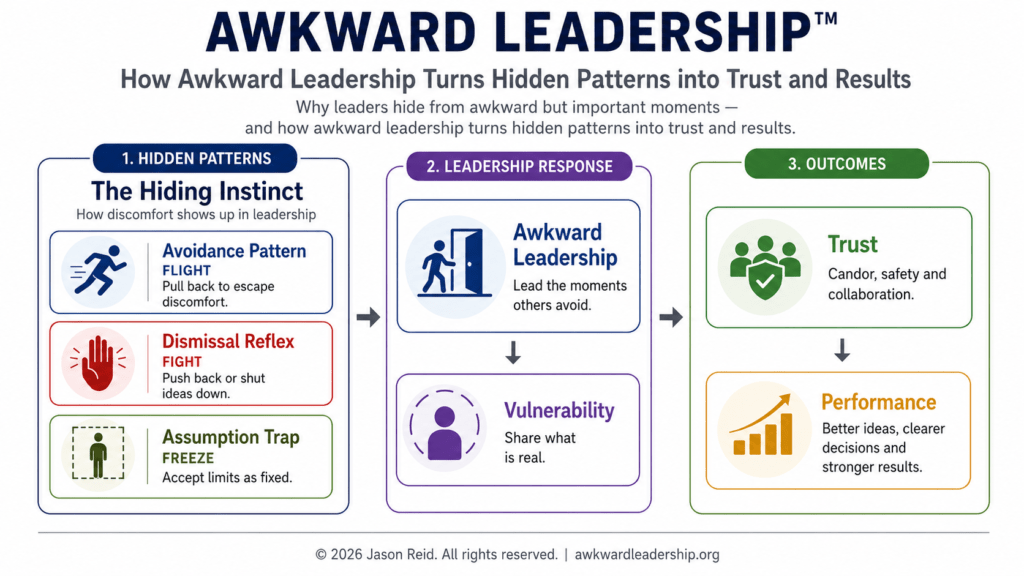
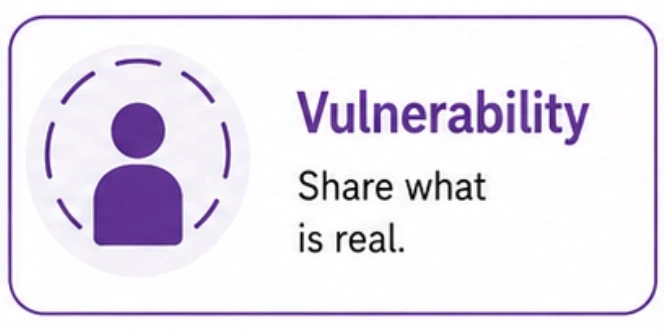
In Awkward Leadership, vulnerability in itself is not the end result, but one of the tools leaders use to overcome the Hiding Instinct.
The goal of vulnerability is not to make work more emotional. The goal is to make the truth more visible.
After all, teams can’t solve what stays hidden. They can’t act on the idea that was dismissed too quickly. They can’t remove the barrier no one felt safe enough to name. They can’t challenge the assumption that everyone quietly accepted.
That is the work of Awkward Leadership. It asks leaders to recognize The Hiding Instinct, stay present in uncomfortable moments, and create enough trust for people to talk about what would otherwise stay hidden.
The moments leaders avoid are often the ones that build the most trust.
And when trust improves, performance follows.
Explore the Awkward Leadership™ Framework
These articles expand on the patterns, choices, and uncomfortable leadership moments behind the Awkward Leadership™ model.
Why Leaders Avoid Difficult Conversations At Work
Why Leaders Dismiss Good Ideas Too Quickly: The Dismissal Reflex
Bring Awkward Leadership to your next event.
Jason Reid delivers keynotes on trust, communication, and the leadership moments most people avoid.