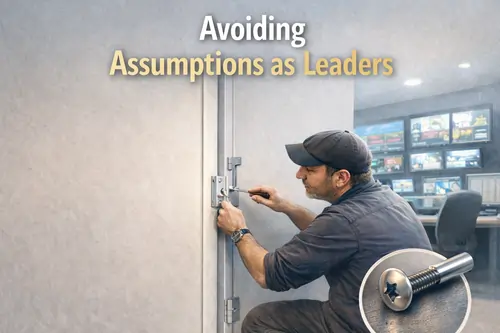
For many organizations, workplace accommodation is still treated as something complex, expensive, and bureaucratic—something that requires committees, policies, meetings, and binders full of documentation.
But sometimes, the barrier isn’t complexity at all. Sometimes it’s assumption.
Early in my management career, I encountered a situation that permanently changed how I think about accommodation, leadership, and assumptions. What started as a serious health concern for a valued employee turned into a powerful lesson about how often we overlook simple solutions because “that’s just the way things have always been.”
I recently shared this story in a video, but I know not everyone prefers to watch. For those who’d rather read—or who want to revisit the story at their own pace—what follows is the verbatim transcript, lightly edited for readability.

The story of our graphic artist
I experienced this firsthand when I was a manager, when I had our control room graphic artist at our television network.
He had a condition where the sheathing of his nerves—the protective sheathing—had been eaten away by a virus, so he was extremely sensitive not only to pain, but also to sound. Loud noise literally caused him to be sick.
And it was really unfortunate, because he was our control room graphic artist, and our control room had a door that was very loud. You’d have to bang it open, bang it closed, bang it open, bang it closed—bang, bang, bang, bang, bang—several times an hour.
Most of us went home with a mild headache. But with this young man, it was a lot more concerning, because he would literally get sick about an hour or two into his shift and would not be able to continue.
Now this was about 10 or 15 years ago, and back then accommodations were seen as a “big thing” that involved lots of meetings and lots of big binders.
[laughter]
Meetings, Policies and Big Binders
So HR got together, we had all these managers get together, and we had meetings about, “How are we going to accommodate this person?”
We looked at, you know, can we move him to a different workstation? Which we couldn’t—he needed to be in a control room. We wondered, okay, can we put him on a different shift? But because we were a 24/7 network, that wouldn’t have worked either.
So we went through all of these different options, spent all this time, and then my boss saw me exiting one of these meetings. He asked me what was going on, and I told him.
The Obvious Question
And he infamously asked me a very obvious but very embarrassing question.
“Is there somebody in the audience who might guess what that question is?”
“Have you thought about fixing the door?”
Uh, no—but hey, that sounds like a good idea.
Now thankfully, working in television, we have engineers all around the place. So I got one of the broadcast engineers and I said, “Can you look at the door frame and see if you can keep it from being so loud?”
So he went in, got the ladder, got some tools. It took five minutes. And the problem was a 10-cent screw that had broken off from the door.
The Assumption That Held Us Back
I think of the hours—the manager hours—that were spent trying to deal with this problem, with all of these big binders, when all it required was changing a 10-cent screw.
Now as you can imagine, this really bothered me. I always thought of myself as a fairly smart person and a good manager, so I thought about this for a while. And then it came to me, and I realized what a great insight it was.
The reason that we hadn’t thought about it was because the door had always been that way. But because it had always been that way, we just made the assumption that it couldn’t be changed.
And that made me look at accommodation in a totally different way, because I realized: how many things in the workplace do we assume cannot be changed simply because they’ve always been that way?